Roulette Online Guide: Rules, Bets, Strategy and Live Play

Last updated: July 2026

Disclaimer: This article is for informational and educational purposes only. Gambling with real money carries financial risks. If you experience difficulties controlling your gambling behaviour, please contact a professional counsellor or organisations such as BeGambleAware (begambleaware.org) or GamCare. No betting system can overcome the mathematical house edge built into roulette.

What Roulette Is and How the Game Works

Roulette is one of the most recognisable casino games in the world. The premise is simple: predict where a ball lands on a spinning numbered wheel. That is it. Whether you play a software-driven (RNG) version or join a live dealer table streamed in HD, the core mathematics stay the same. Each spin is independent, the house always holds a statistical edge, and no strategy can change the expected value of a bet.

This guide walks you through every element of the roulette game: the structure of the wheel and table, all bet types with exact payouts and probabilities, the differences between European, American and French roulette, the technology behind live and RNG games, how demo mode compares with real-money play, and practical bankroll management rules. Along the way you will find research-backed insights, comparison tables, and a responsible gambling framework to help you make informed decisions before playing roulette with actual money.

What Roulette Is and How the

The Roulette Wheel, Table and Flow of a Round

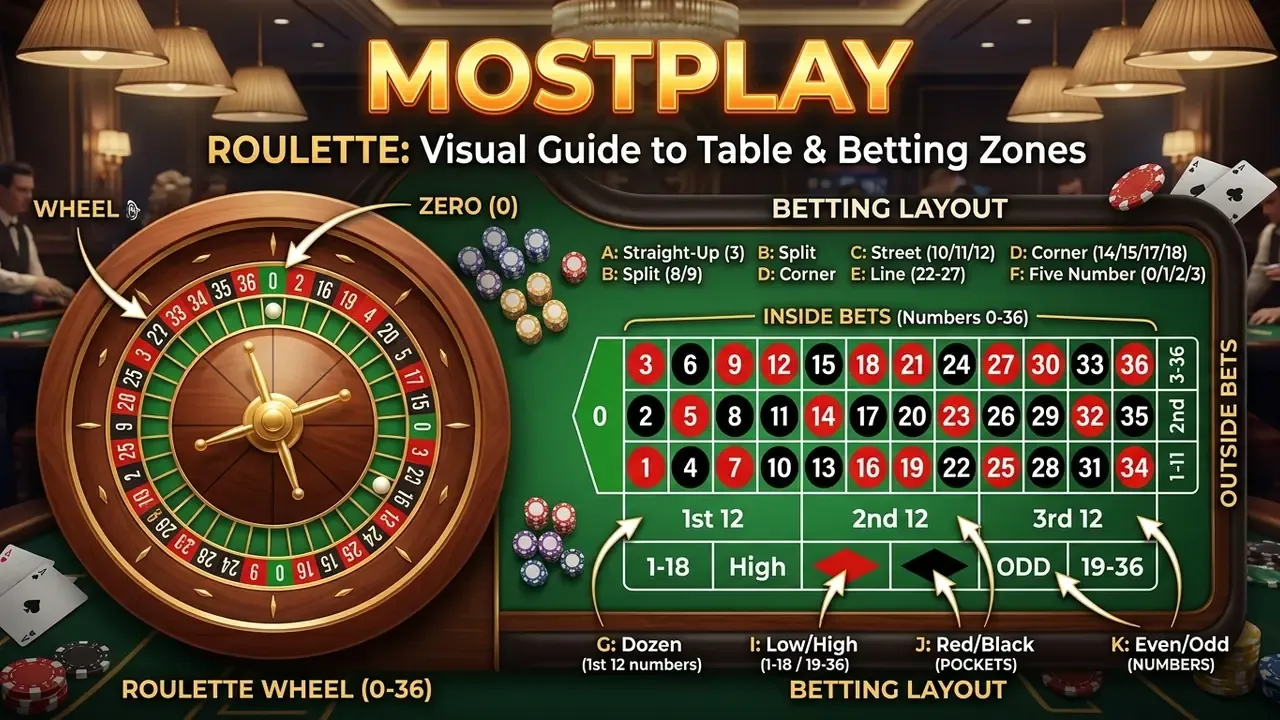
The game centres on two physical components: the roulette wheel and the roulette table layout.

The European wheel contains 37 pockets: numbers 1 through 36 alternating between red and black, plus a single green zero (0). Here is the exact colour breakdown:

NumbersColour
1, 3, 5, 7, 9, 12, 14, 16, 18, 19, 21, 23, 25, 27, 30, 32, 34, 36Red
2, 4, 6, 8, 10, 11, 13, 15, 17, 20, 22, 24, 26, 28, 29, 31, 33, 35Black
0Green

The numbers on the wheel are arranged in a non-sequential order. This is deliberate. The layout distributes odd/even, high/low, and red/black numbers as evenly as possible around the circumference, so no section of the wheel favours one category.

The American wheel adds a second green pocket, the double zero (00), bringing the total to 38 pockets. That single extra pocket is the structural change responsible for a significantly higher house edge. More on that in the variants section below.

The roulette table layout splits into two main areas:

  • Inside betting area: A numbered grid where players place bets on specific numbers or small groups of adjacent numbers.
  • Outside betting area: Sections for broader groupings like columns, dozens, red/black, odd/even, and high/low (1 to 18 or 19 to 36).

Flow of a standard round:

  1. Betting window opens. The dealer (or the software interface in RNG versions) signals that bets are accepted. Players select chip denominations and position them on the layout.
  2. Betting window closes. The dealer announces "No more bets" (in live games) or a timer expires (in RNG games). After this point, chips cannot be added, moved, or removed.
  3. The spin. The roulette wheel rotates and the ball is released in the opposite direction. In RNG versions, the outcome is determined by a certified pseudorandom number generator at the instant the spin triggers.
  4. Result and settlement. The ball comes to rest in a numbered pocket. The winning number is announced, losing bets are cleared, and winning bets are paid according to the fixed payout table.
  5. Table reset. The layout is cleared and a new betting window opens.

In RNG online roulette, steps 2 through 5 happen almost instantaneously, often within a few seconds, because there is no physical wheel. In live dealer roulette, a full round typically takes 30 to 60 seconds or more, depending on the variant. Speed Roulette can complete a round in roughly 25 seconds.

The integrity of these outcomes rests on independence: each spin is a separate random event, unaffected by any prior result.


The numbers on the wheel are

"Knowledge of previous numbers must not provide information about future ones - each spin is independent." - State of Connecticut (2024), Technical Standards for Online Casino, Lottery, and Keno Systems. https://portal.ct.gov/DCP/Gaming-Division/Gaming-Division/Technical-Standards

This regulatory requirement means certified online roulette games cannot have "memory" that adjusts probabilities based on prior results. No hidden mechanisms shift the odds after streaks or patterns.

What Makes Roulette a Casino Classic

Roulette occupies a unique position among casino games. Unlike blackjack or poker, which require memorising strategy tables or reading opponents, roulette permits immediate participation with just a basic understanding of bet categories. A player can place a chip on red or black and instantly understand the wager. Meanwhile, more experienced participants explore splits, corners, streets, and specialty wagers.

This dual-layer accessibility, simple on the surface yet deep enough for analytical players, has kept roulette relevant for more than two centuries. Major iGaming platforms consistently feature roulette among their most visible table games, leveraging the game's cultural familiarity and straightforward structure.

However, it is important to understand that roulette is, by design, a game with a negative expected value for the player. Every standard wager carries a built-in casino advantage. That is not a flaw. It is the business model.

What Makes Roulette a Casino Classic

"Roulette is modelled as a supermartingale: the player's expected capital decreases over time under any betting strategy." - University of Chicago REU Program (2023), Martingales in Gambling and Finance. https://math.uchicago.edu/~may/REU2023/

Research into player behaviour reinforces roulette's psychological pull. An analysis of 1,909,681 sessions from 15,544 players on the PlayNow.com platform in British Columbia found that roulette exhibited the highest intensity of chasing behaviour among all casino game types, with statistically significant coefficients (loss-chasing b = -0.13, p < 0.001; win-chasing b = -0.08, p < 0.001). That heightened engagement can tip into risky patterns if left unchecked.

Journal of Behavioral Addictions (2024), analysis of PlayNow.com player data. https://doi.org/10.1556/2006.2024.00001

This is precisely why understanding the rules, the odds, and the tools of responsible play matters before sitting down at any roulette table, virtual or physical.

Roulette Rules for Beginners

If you have never played roulette before, the rules are more approachable than they might look at first glance. The entire game boils down to a few steps: choose your bet, place your chips, wait for the spin, and see if the ball lands where you predicted. Let us break that down.

How to Place Bets and When the Spin Starts

Here is the simplest path to your first spin:

  1. Select your chip value. In most online interfaces, chip denominations appear at the bottom of the screen. Click or tap the value you want to use (for example, 0.10, 1, 5, or 25 in your local currency).
  2. Place your chip on the roulette table. Click or tap the area of the layout corresponding to your desired bet. Clicking the "Red" diamond places an even-money bet on all red numbers. Clicking a single number square places a straight-up bet. You can place multiple bets on the same round.
  3. Confirm and spin. Once satisfied with your bets, press the "Spin" button in RNG roulette, or wait for the live dealer to close the betting window and spin the wheel.

The betting window has a clear open and close point. In live games, the dealer verbally announces when bets are accepted and when they close. In RNG games, you control the pace, so there is no rush. Take your time to understand where your chips sit before confirming.

Four common beginner mistakes to avoid:

  • Late betting. Attempting to place or move chips after "No more bets" has been announced. The wager will simply be rejected.
  • Confusing inside and outside bets. These have very different payout structures. Placing a chip in the wrong zone changes both the odds and the potential return.
  • Misreading the payout table. A split bet (17:1) and a street bet (11:1) look similar on the layout but pay very differently.
  • Ignoring bankroll limits. Playing roulette without a pre-set budget is the fastest path to losses that exceed your comfort level.
How to Place Bets and When

What Happens After the Ball Lands

Once the roulette wheel stops and the ball settles into a numbered pocket, the round resolves quickly:

  • The winning number is identified, either by the dealer's visual confirmation (live games) or by optical/RFID sensors and software (both live and RNG).
  • Losing bets are cleared from the table.
  • Winning bets are paid out according to the fixed payout ratios. For example, a straight-up bet on the winning number pays 35:1. A red/black bet pays 1:1.
  • Your balance updates automatically in online roulette. In live games, the digital interface handles the calculation.

Then the cycle restarts. A new betting window opens, and you decide whether to place another bet, adjust your approach, or step away from the table. That last option, stepping away, is always available and always valid.

What Happens After the Ball Lands

Inside Bets, Outside Bets and Roulette Payouts

Understanding the full range of available bets is the foundation of informed roulette play. Every bet type has a fixed payout ratio and a mathematically determined probability of winning. In European roulette (37 pockets), the house edge on nearly every standard bet is 2.70%. In American roulette (38 pockets), it rises to 5.26%.

Inside Bets on the Roulette Table

Inside bets target specific numbers or small clusters of numbers within the numbered grid. They offer higher payouts but lower probabilities of winning.

Bet TypeNumbers CoveredPayoutWin Probability (European)Example
Straight Up135:12.70%Bet on 17
Split217:15.41%Bet on 17/20 border
Street311:18.11%Bet on 1/2/3 row
Corner (Square)48:110.81%Bet on 25/26/28/29 junction
Six Line65:116.22%Bet on 1 to 6 (two rows)

The higher payouts of inside bets come with correspondingly lower hit rates. A straight-up bet pays 35:1 but hits only 2.70% of the time. That means you can expect long stretches without a win. This leads to dramatic swings in bankroll, with occasional large profits but a real risk of hitting table limits or exhausting your capital before a win arrives.

"Simulations show that the Martingale system does not improve expected value and sharply increases the risk of total ruin with a limited bankroll." - Sacred Heart University (2024), poster Martingale Strategy in Roulette (Python simulations). https://digitalcommons.sacredheart.edu/

This finding applies to any progressive system applied to inside bets. Doubling down after losses does not change the underlying probability. It only changes the distribution of outcomes, concentrating risk into catastrophic loss events.

Outside Bets for Simpler Roulette Play

Outside bets cover larger groups of numbers and sit along the perimeter of the roulette table layout. They win more frequently but pay less.

Bet TypeNumbers CoveredPayoutWin Probability (European)Example
Red / Black181:148.65%All red numbers
Odd / Even181:148.65%All odd numbers
High / Low181:148.65%1 to 18 or 19 to 36
Dozen122:132.43%1st 12, 2nd 12, or 3rd 12
Column122:132.43%1st, 2nd, or 3rd column

Notice that the zero (and double zero, in American roulette) is not covered by any outside bet. This is precisely how the casino maintains its edge. Zero reduces every outside bet's hit rate by 1/37 (European) or 2/38 (American) versus what it would be on a zero-free wheel.

The fundamental trade-off in roulette is consistent: the fewer numbers your bet covers, the higher the payout but the lower the probability of winning. The house edge, however, remains constant across nearly all standard bet types in European roulette at 2.70%. No combination of bets can reduce the casino's mathematical advantage on a standard European wheel. You are simply choosing between higher variance (inside bets) and lower variance (outside bets) while the long-run cost per unit wagered stays the same.

[Comparison table: Inside bets vs outside bets, showing bet type, brief description, risk level (high/medium/low), and payout format for each category]

Notice that the zero and double

European, American and Other Roulette Games

European vs American Roulette

The most consequential difference between roulette games comes down to the number of zero pockets. Everything else follows from that.

FeatureEuropean RouletteAmerican Roulette
Pockets37 (0 + 1 to 36)38 (0 + 00 + 1 to 36)
House Edge2.70%5.26%
RTP97.30%94.74%
Extra BetNoneFive Bet (0, 00, 1, 2, 3) at 6:1

Mathematically, adding the 00 pocket increases the number of losing outcomes on even-money bets from 19/37 to 20/38. That reduces RTP by 2.56 percentage points. For players choosing purely by payout advantage, European roulette is the more favourable option. Worth knowing before you pick a table.

French roulette uses the same 37-pocket European wheel but introduces two player-friendly rules:

  • La Partage: If the ball lands on zero, players who placed even-money bets (red/black, odd/even, high/low) lose only half their stake instead of the full amount. This effectively reduces the house edge on those bets to approximately 1.35%.
  • En Prison: An alternative to La Partage offered at some tables. When zero hits, even-money bets are "imprisoned" for the next spin rather than halved. If the next spin wins, the full bet is returned. If it loses, the bet is forfeited.

These rules make French roulette the most mathematically favourable standard variant for even-money bettors. The ranking by house edge on even-money bets is: French (~1.35%) > European (2.70%) > American (5.26%).

Research into betting systems confirms that the structural differences between variants matter far more than any staking pattern. A study from UNLV demonstrated that in a fair game, the Paroli and Martingale systems have identical moments and are statistically equivalent apart from whether bets increase after wins or losses. Once the house edge is introduced, both yield negative expected value.

Mathematically, adding the 00 pocket increases

"In a fair game, Paroli and Martingale have identical moments; with a house edge, both produce negative expectation." - UNLV (2026), Paroli and Let-It-Ride Betting Systems in Roulette. https://digitalscholarship.unlv.edu/

Live, Auto and Specialty Roulette Formats

Beyond the three classic variants, modern iGaming platforms offer a range of formats that alter the pace, presentation, or payout structure of roulette. Here is what you will encounter:
  • Live Dealer Roulette -A real croupier operates a physical wheel in a studio (or on a casino floor), and the action is streamed in HD to the player's device. Players place bets through a digital interface layered over the video feed. Interaction with the dealer via live chat is standard. The result is determined by the physical bounce of the ball, not by software.
  • Auto Roulette -A live, real wheel spins continuously without a human dealer. An automated mechanism launches the ball, and optical sensors read the result. This format supports faster rounds. Some tables run over 2,500 games per day while still relying on a physical wheel rather than RNG.
  • Speed Roulette -A live dealer variant where rounds take approximately 25 seconds from spin to spin, roughly 50% faster than standard live roulette. Betting occurs only during the spin itself.
  • Immersive Roulette -Developed by Evolution, this variant uses multiple high-definition cameras to deliver close-up angles of the wheel and ball, including slow-motion replays of the winning number as the ball comes to rest. It feels cinematic, honestly.
  • Lightning Roulette -An Evolution game that overlays RNG-generated multipliers onto a standard live roulette round. In each round, between one and five "Lucky Numbers" are randomly selected and assigned multipliers of 50x to 500x on straight-up bets. Standard straight-up payouts are reduced to 29:1 (from 35:1) to fund the multiplier pool, keeping the overall RTP in line with standard roulette.
  • XXXtreme Lightning Roulette -An amplified version of Lightning Roulette. Chain Lightning generates up to nine additional lucky numbers per round (up to ten total), and Double Strike Multipliers can stack on those numbers, pushing potential payouts on a single straight-up bet to up to 2,000x.
  • Double Ball Roulette -Two balls are launched simultaneously from a patented device, producing two winning numbers per spin and opening unique bet types with payouts up to 1,300:1.
  • Instant Roulette -Twelve synchronised Auto Roulette wheels spin almost continuously. The player bets at their own pace and, when ready, the system selects the wheel closest to dropping its ball.
  • Dual Play Roulette -Bridges land-based and online play by seating online players at a physical casino table alongside in-person players, with cameras capturing the action for remote participants.
Live, Auto and Specialty Roulette Formats

One thing to keep in mind: specialty formats like Lightning Roulette adjust the standard payout structure to compensate for the added multiplier potential. The reduced base payout on straight-up bets (29:1 instead of 35:1) ensures the house edge remains comparable to standard roulette. Always review the specific rules of any specialty x roulette game before wagering.

Roulette Online, Roulette Demo and Real Money Play

When Roulette Demo Is the Better Choice

Many online casinos offer free-play or demo versions of their RNG roulette games. These versions use the same software and the same random number generators as the real-money equivalents, but with virtual credits instead of actual funds. Roulette demo mode is a practical tool in several specific scenarios:

  1. Learning the interface of a new provider. Different software studios lay out chip selectors, bet confirmation buttons, and statistics panels differently. Demo mode lets you familiarise yourself with the UI without risking money on misclicks.
  2. Testing auto-spin speed and settings. If you want to understand how fast an auto-play feature cycles through spins, or how a "repeat bet" function works, demo play lets you experiment freely.
  3. Exploring unfamiliar bet types. If you have never placed a corner bet or a six-line bet, demo mode gives you a zero-risk environment to see how the chip placement works and what the payouts look like.
  4. Getting comfortable with the pace. Some players find the speed of RNG roulette disorienting at first. A few demo rounds help you settle into the rhythm before any money is on the line.

It is important, however, to recognise that demo play does not replicate the psychological conditions of real-money gambling. The absence of financial risk fundamentally changes decision-making and emotional response. When nothing is at stake, you might bet aggressively or carelessly. That behaviour rarely transfers well to real money sessions. Demo experience should be viewed as a tool for learning mechanics rather than as a predictor of future performance under financial pressure.

When Roulette Demo Is the Better

"An analysis of operator communications shows that the quality of responsible gambling language varies substantially between platforms." - Gaming Research and Review Journal, Vol. 28, Issue 1, Evaluating Language and Communication Surrounding Responsible Gambling. https://digitalscholarship.unlv.edu/grrj/vol28/iss1/

This variability is one more reason to approach demo play, and the platform offering it, with informed scepticism rather than blind trust.

Note: Live dealer roulette games are typically not available in demo mode. Because a live game requires a real dealer, real equipment, and real-time streaming, free-play versions are not operationally viable. If you want to observe a live roulette game before betting, some platforms allow you to watch as a spectator without placing wagers.

What Changes in Real Money Roulette

Important: Real money roulette carries the risk of financial loss. Demo play does not replicate the emotional pressure or decision-making conditions of wagering actual funds. Set your limits before you start. If you experience difficulties controlling your gambling behaviour, please seek help from BeGambleAware (begambleaware.org), GamCare, or the National Council on Problem Gambling.

When you transition from demo play to roulette real money, several things change at once:

  • Financial consequence becomes real. Every chip represents actual money. This introduces stress, emotional decision-making, and the risk of chasing losses. The difference in how you feel after losing 500 virtual credits versus 500 real rupees is, well, enormous.
  • Bankroll management becomes essential. Without a pre-set budget, it is easy to wager more than intended. Set a hard limit before your first spin.
  • Wagering requirements apply to bonuses. If you accept a casino bonus, be aware that roulette bets often contribute only 5 to 10% toward bonus wagering requirements. A 1,000 INR bet on roulette might count as only 50 to 100 INR toward playthrough. Always read the full terms before accepting a bonus. This is not a minor detail.
  • Payment and withdrawal processes matter. For players in India, check whether the roulette casino supports INR deposits, UPI, NetBanking, or e-wallets. Also verify withdrawal timelines and KYC requirements before depositing.

Research supports the effectiveness of targeted, personalised responsible gambling interventions during real-money play:

When you transition from demo play

"Personalised warnings about current losses reduce wager amounts significantly compared with generic messages (p = 0.035) and control conditions (p < 0.001)." - Pilot experiment with simulated online roulette (2019). https://doi.org/10.1007/s10899-019-09865-0

A broader systematic review of 20 studies confirmed that self-appraisal messages, those prompting the player to reflect on their own behaviour, are more effective at reducing risky gambling than purely informative messages about odds.

"Self-appraisal messages are more effective at reducing risky behaviour than general odds-based information." - PubMed, systematic review of responsible gambling messaging effectiveness (2023-2024). https://pubmed.ncbi.nlm.nih.gov/

Official guidance from the UK Gambling Commission and BeGambleAware emphasises several practical tools:

  • Set a deposit limit before you start playing roulette.
  • Set a time limit for each session.
  • Use reality checks, periodic pop-ups that tell you how long you have been playing and how much you have spent.
  • Stop when your limit is reached, whether it is a time limit or a money limit.
  • Use self-exclusion if you feel you are losing control.

Live Dealer Roulette vs Standard Online Roulette

How Live Dealer Roulette Works

Live dealer roulette combines physical casino equipment with digital streaming and betting infrastructure. The core components are:

  • Physical wheel and ball. A real roulette wheel is spun by a trained croupier. The ball's trajectory and final resting pocket are determined by physics, not by software.
  • HD video streaming. Multiple cameras (often three or more) capture the table from different angles. The feed is compressed and delivered to the player's device with minimal latency, typically under two seconds.
  • Optical/RFID recognition. Sensors embedded in or around the wheel read the winning number as the ball settles. This automated reading is cross-checked against the dealer's visual confirmation to ensure accuracy.
  • Digital betting interface. The player sees the live video overlaid with a clickable/tappable table layout. Bets are placed through this interface during the open betting window and transmitted to the game server.
  • Game server and audit trail. Every bet, every spin result, and every payout is logged in a central server with full audit capability, as required by licensing regulators.

The social element is genuine. You can chat with the dealer and sometimes with other players at the table. For many people, that interaction is what makes live casino roulette feel closer to a real casino floor than any RNG game can.

How Live Dealer Roulette Works. Live

Main Benefits and Trade-offs of Live Roulette

Here is an honest comparison of the two formats:

FeatureLive Dealer RouletteRNG Online Roulette
Result generationPhysical ball on physical wheelCertified pseudorandom number generator
Round duration~30 to 60 seconds (25s in Speed Roulette)Near-instant (~3 to 5 seconds)
Social interactionLive chat with dealer and sometimes other playersNone
TransparencyVisible physical processAlgorithm audited by third parties (e.g. eCOGRA, iTech Labs)
Betting time limitFixed window (typically 15 to 30 seconds)Unlimited (player controls pace)
Minimum betOften higher (e.g. 0.50 to 1.00 in base currency)Often lower (e.g. 0.10 in base currency)
Internet dependencyHigh, stream interruption can cause missed betsLower, only needs data for bet submission
AtmosphereImmersive, real-time, human presenceFunctional, fast, private

Limitations worth knowing:

  1. Strict betting time limits. You must place all bets within a fixed window. If you are still deciding when the window closes, your bet is not accepted.
  2. Internet stability dependency. A dropped connection or high latency can prevent you from placing or confirming a bet in time, or cause the video feed to freeze. This is especially relevant for mobile players in areas with inconsistent connectivity.
  3. Dealer and technical pauses. Dealer changes, equipment adjustments, or studio technical issues can interrupt the flow of play. RNG games run continuously without external dependencies.
  4. Higher minimum stakes. The cost of operating a physical studio with professional dealers is reflected in generally higher minimum bet requirements.

Are live roulette tables fair? Licensed live roulette games are subject to the same regulatory oversight as any other casino product. Operators must hold valid licences from bodies such as the UK Gambling Commission (UKGC), the Malta Gaming Authority (MGA), or the Gibraltar Gambling Commission. Independent testing agencies audit both the physical equipment and the digital systems. The physical nature of live roulette, where you can watch the ball spin on a real wheel, adds a layer of visible transparency. Combined with regulatory auditing, this makes rigging a live roulette table extraordinarily difficult and easily detectable.

Limitations worth knowing 1. Strict betting

Roulette Strategy: What Helps and What Is a Myth

Let us be direct. Every roulette spin is an independent event. The probability of any specific outcome on the next spin is fixed by the number of pockets on the wheel, not by what happened on previous spins. This is the foundational principle that makes roulette a negative-expectation game for the player, regardless of how bets are sized or sequenced.

Popular systems like the Martingale (double after a loss), Fibonacci (increase bets following the Fibonacci sequence after losses), and D'Alembert (increase by one unit after a loss, decrease by one unit after a win) are all variations on the same theme. They change the distribution of outcomes across a session but do not change the expected value of each bet. Over a large number of spins, the house edge applies to every unit wagered.

The critical vulnerability shared by all progressive systems is the table limit. Casinos impose maximum bet caps, which means a losing streak will eventually prevent the player from continuing the progression. At that point, the accumulated loss cannot be recovered by the next bet.

Here is a quick example. Starting with a 100 INR Martingale bet on red, after just seven consecutive losses you would need to bet 12,800 INR on the eighth spin. Many tables cap at 10,000 INR or lower. The system breaks before the recovery bet is even possible.

Popular Betting Systems Players Try. Let

How to Use Strategy Without False Expectations

If no system beats the house edge, what can a player actually control? Behaviour. That is the honest answer.

The gambler's fallacy is the belief that past outcomes influence future probabilities in independent events. The classic roulette example: "Red has come up 10 times in a row, so black is due." In reality, the probability of red on the next spin remains exactly 18/37 (European roulette, roughly 48.65%) regardless of any streak. The wheel has no memory.

This cognitive bias is well-documented in probability theory and behavioural research. Recognising it in yourself is, arguably, the most valuable "strategy" you can develop.

Fact check on common myths:

  • "You can beat roulette with the right system." No. Every peer-reviewed simulation and mathematical proof confirms that no betting pattern overcomes the house edge over time.
  • "Streaks of red/black affect the next spin." No. Each spin is an independent trial. The outcome of spin n provides zero information about spin n+1.
  • "Strategy makes roulette a winning game." No. Strategy can manage your bankroll and session length. It cannot turn a negative-expectation game into a positive one.

Four practical bankroll management rules:

  1. Flat betting (fixed unit size). Choose a single bet size and keep it constant for every spin. This is the simplest way to control variance and avoid the exponential risk of progressive systems.
  2. Hard stop-loss. Before you begin, set a maximum loss amount for the session. When that limit is reached, stop playing. No exceptions.
  3. Session win cap. Similarly, set a target profit. If you reach it, end the session. This prevents the common pattern of "giving back" a winning run.
  4. Fixed session bankroll. Allocate only a pre-determined fraction of your total bankroll to any single session. If the session bankroll is exhausted, the session is over. You do not dip into reserves.

These rules do not change the mathematics of the game. They change your behaviour. And behavioural discipline is the only variable a player actually controls.

How to Use Strategy Without False

How to Choose a Roulette Casino or Live Casino Table

What to Check Before You Play Roulette Online

Not all online casinos are created equal. Before depositing real money to play roulette, verify the following. Think of it as a pre-flight checklist.

Five objective criteria:

  1. Valid regulatory licence. Look for licences from established bodies: the UK Gambling Commission (UKGC), the Malta Gaming Authority (MGA), the Gibraltar Gambling Commission, or equivalent regulators in your jurisdiction. A licence means the operator is subject to enforceable standards for fairness, security, and responsible gambling. No licence? Walk away.

  2. Independent RNG auditing. Reputable casinos have their random number generators tested and certified by independent labs such as eCOGRA, iTech Labs, or GLI. Look for certification seals and published audit reports, typically found in the site footer.

  3. Published game rules and RTPs. A trustworthy roulette casino publishes the rules, payout tables, and Return to Player percentages for every game. If this information is hidden or absent, treat it as a red flag.

  4. Responsible gambling tools. Deposit limits, loss limits, session time limits, reality checks, cooling-off periods, and self-exclusion options should all be readily accessible from your account settings. Not buried in obscure menus.

  5. Secure payment processing. All financial transactions should be encrypted (look for HTTPS and SSL/TLS certification). For Indian players specifically, check that the casino supports INR, UPI, NetBanking, or popular e-wallets. Verify that withdrawal processes and timescales are clearly documented before you deposit.

Interface quality checklist for the roulette game itself:

  • Hot/cold number statistics displayed within the game interface
  • Repeat bet / rebet button for quick re-placement of previous wagers
  • Save betting pattern function to store complex multi-chip layouts
  • Clear chip denomination selector with easy switching between values
  • Responsive design that works well on both desktop and mobile screens, including portrait orientation on smartphones
  • Visible bet history and results log for reviewing past rounds

India-specific considerations: Mobile-first access matters. A large share of Indian players access online roulette through smartphones. Test the mobile experience before committing funds. Check whether the roulette casino offers a dedicated app or a well-optimised browser version. Also confirm that customer support is available in English and responsive during Indian time zones.

What to Check Before You Play

FAQ About Roulette Online and Live Play